If you have ever searched "how much are contacts" and felt more confused after seeing the results, you are not alone. One retailer lists a box at $35. Another charges $65 for the exact same SKU. A private optometrist quotes $800 for a year supply, while an online banner advertises "50% off."
The honest answer to "how much are contacts" is not a single number. It is a formula. Most price guides give you a table of box prices and call it a day. That is not economics. That is a catalog.
This guide explains why contact lens cost varies by 300% for the same prescription. More importantly, it shows how to calculate how much contacts cost using a metric almost no one talks about: your true cost per wear.

Why "How Much Are Contacts?" Is the Wrong Question
Most shoppers ask "what is the contacts price?" and get a box price. That is like asking what a car costs by looking only at the monthly lease payment.
The sticker price on a box of contact lenses is just the visible tip. Under the surface, four invisible forces determine what you actually pay. Until you understand them, you cannot comparison-shop. You are just guessing.
The real question is not "how much are contacts?" It is "what is my contact lens total cost of ownership per actual wear?"

The 4 Invisible Forces Behind Contact Lens Price Swings
Force 1: Channel Economics (Doctor vs. Costco vs. Online)
Here is the first counter-intuitive truth: contact lens online vs doctor pricing is not a simple win for the internet. We tracked the same Acuvue Oasys 1-Day 90-pack across five purchase channels in July 2026. The per-box spread was $18. But the net cost after rebates and vision insurance coverage diverged by over $200 annually.
Why? Because prescription contacts price structures are built like airline tickets. The base fare is only half the story.
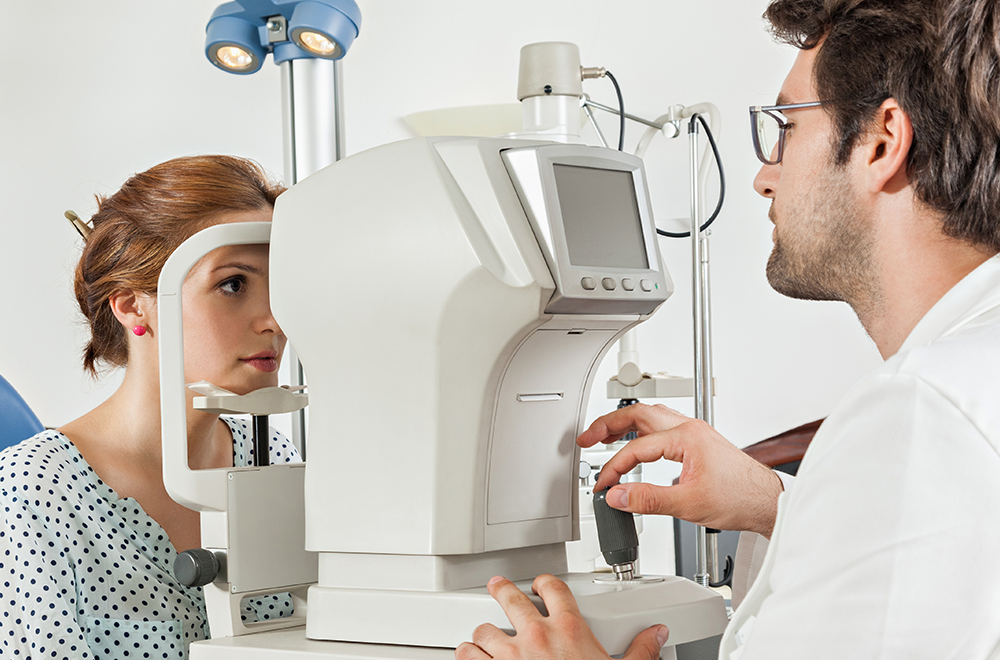
Private optometrists charge higher per-box prices but often bundle manufacturer rebates of $200–$400 on annual supplies. They also apply in-network contact lens insurance directly at checkout.
Costco wins on per-box price but caps year-supply rebates around $150. If you have strong vision insurance, the rebate gap can erase Costco's advantage. Shoppers often wonder how much are contact lenses at costco compared to private practices, but does costco sell contact lenses at a true discount only if you bypass insurance rebates.
Online retailers (1-800 Contacts, Lens.com) offer convenience and subscription discounts, but they are typically out-of-network. You pay full price upfront and self-submit for lower out-of-network reimbursement.
The takeaway: the lowest contacts price per box rarely equals the lowest annual contact lens cost.
Force 2: The Insurance & Rebate Layer
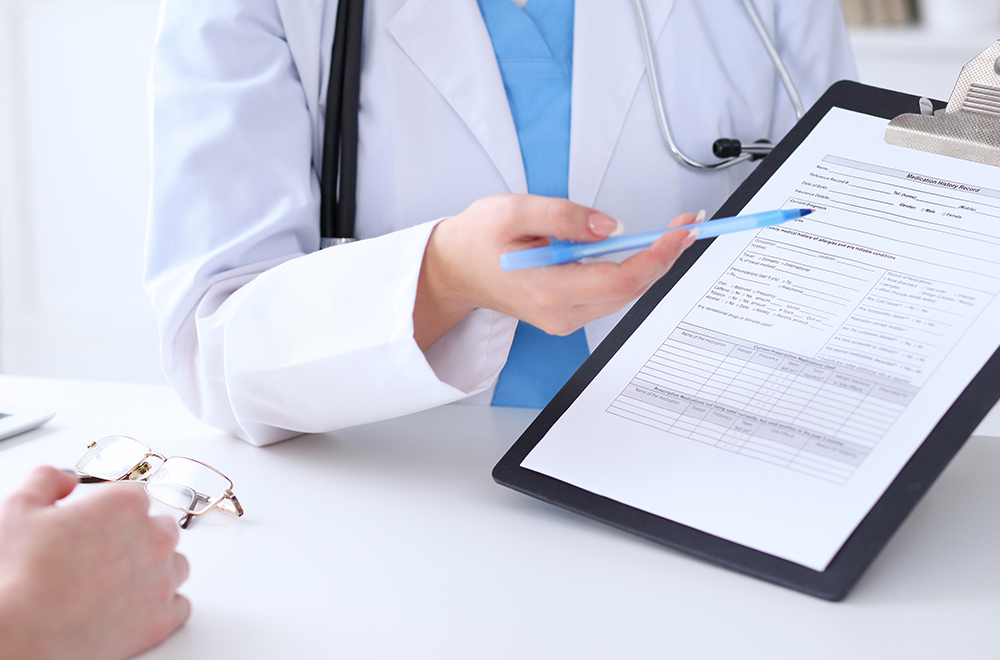
Contact lens insurance is not a simple discount card. It is a rebate and reimbursement stack. A VSP or EyeMed in-network plan often covers the contact lens exam cost and contact lens fitting fee (a $100–$250 combined value). Then it applies a materials allowance directly to the lens purchase.
This leads many to ask: does insurance cover contact lenses, and how much do contact lenses cost with insurance versus paying out of pocket? The answer depends on your plan tier and whether your provider is in-network. If you are uninsured, understanding how much do contacts cost without insurance is critical—retail prices can double your annual outlay.
Manufacturer programs (Acuvue Rewards, Alcon Rewards, CooperVision offers) are separate from insurance. They require an annual supply purchase and valid prescription. New-wearer rebates are often $50–$100 higher than existing-wearer rebates.
If you skip the annual supply and buy quarterlies, you forfeit both the bulk discount and the contact lens rebate. That decision alone can raise your effective contact lens cost by 30–40%.
Force 3: The FSA/HSA Tax Shield (2026 Limits)
This is the most underutilized lever in contact lens budget planning. The IRS classifies prescription contact lenses as a qualified medical expense. That means you can pay with pre-tax FSA or HSA funds.
For 2026, the FSA contribution limit is $3,400. The HSA limit is $4,400 for individual coverage ($8,750 for family). If you are in the 24% federal tax bracket, using FSA HSA contacts dollars is equivalent to a 24–37% instant discount, depending on your state tax. A $600 annual lens bill becomes a $450 net cost.
Yet most wearers never stack this with manufacturer rebates. The smartest buyers triple-stack: in-network insurance + manufacturer rebate + FSA/HSA payment. That is how a $900 annual bill collapses to under $400.
Before you ask can i use hsa for contact lenses or can i use fsa for contact lenses, check with your plan administrator. Most vision expenses qualify, but rules vary by employer. Many people also wonder are contact lenses fsa eligible—yes, as long as they correct vision and you have a valid prescription.

Force 4: Prescription Complexity Premium
Not all prescriptions are priced equally. Standard spherical lenses for myopia or hyperopia sit at the bottom of the pricing ladder.
Add astigmatism correction (toric lenses) and manufacturing complexity increases because the lens must maintain rotational stability on the eye. Add presbyopia (presbyopia lenses / multifocal designs) and the lens must balance multiple optical zones.
The result: toric lenses cost 20–40% more than spherical equivalents. Multifocal contacts price can push annual costs above $1,000 before insurance. Even colored contacts cost carries a design premium if they incorporate vision correction, though plano cosmetic lenses avoid this layer entirely.
If you have astigmatism, you may ask what are toric contact lenses—or what is toric contact lenses exactly—and why they cost more. The answer lies in the specialized stabilization design. Others wonder what are multifocal contact lenses—these correct both distance and near vision in one lens. Some patients even ask can you get bifocal contact lenses or can contact lenses correct astigmatism. The answer to both is yes, though these specialized designs raise the price significantly. Shoppers often ask how much are contact lenses for astigmatism or how much are multifocal contact lenses before committing to a modality.

Cost Per Wear: The Only Metric That Matters
Academic research published in peer-reviewed optometry journals confirms what savvy shoppers already suspect: annual cost comparisons are misleading unless you factor in wear frequency. A cost-per-wear model divides your total annual outlay by the number of times you actually insert lenses.
The results overturn conventional wisdom about how much are daily contacts, how much are monthly contacts, and how much do eye contacts cost over a full year.
|
Lens Type
|
Wear Frequency
|
Annual Lens Cost
|
Solution Cost
|
Exam/Fitting
|
Total Cost
|
Wears/Year
|
Cost Per Wear
|
|
Daily Disposable
|
Daily (365 days)
|
$750
|
$0
|
$150
|
$900
|
365
|
$2.47
|
|
Daily Disposable
|
3 days/week
|
$320
|
$0
|
$150
|
$470
|
156
|
$3.01
|
|
Monthly
|
Daily (365 days)
|
$256
|
$175
|
$150
|
$581
|
365
|
$1.59
|
|
Monthly
|
3 days/week
|
$256
|
$175
|
$150
|
$581
|
156
|
$3.72
|
|
Bi-weekly
|
Daily (365 days)
|
$389
|
$130
|
$150
|
$669
|
365
|
$1.83
|
|
Yearly Colored
|
3 days/week
|
$6
|
$40
|
$150
|
$196
|
156
|
$1.26
|
Data compiled from 2026 retail pricing across major US retailers and contact lens solution cost averages. Exam/fitting fees averaged at $150.
Notice the inversion. At full-time daily wear, monthlies are the clear winner at $1.59 per wear. Many shoppers first ask how much are daily contact lenses before realizing the per-wear math changes everything. But drop to three days per week, and monthlies balloon to $3.72 per wear. You still replace them every 30 days regardless of use count.
Meanwhile, dailies at three days per week drop to $3.01 per wear. If you are calculating how much do contacts cost monthly, remember that monthlies include solution expenses that dailies avoid entirely. The breakpoint where daily and monthly contacts price economics converge is approximately five days per week. Below that threshold, dailies become financially rational, not just convenient.
This is where many shoppers ask are daily contacts more expensive than monthlies. The truth applies equally to all daily contact lenses, regardless of brand. The truth depends entirely on your wear schedule, not the box price. If you are comparing what are daily contact lenses versus what are monthly contact lenses, the key difference is replacement cadence—and that cadence determines whether you waste unused lens days.
Some wearers also want to know are monthly contact lenses cheaper than daily options. At full-time wear, yes. At part-time wear, often no. Understanding what's the difference between monthly and daily contact lenses is essential before you buy a year supply.
The Hidden Cost Layer Most Guides Ignore
The Solution Tax
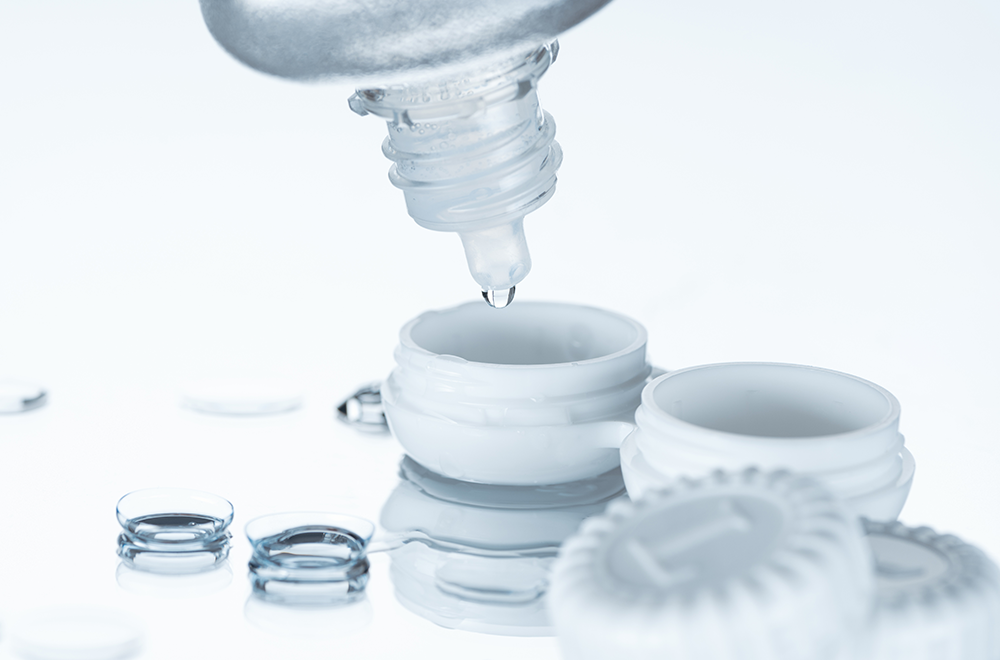
Reusable lenses carry a recurring tax: contact lens care products. A 12-month supply of multipurpose solution runs $150–$200. Hydrogen peroxide systems (preferred for sensitive eyes) add another $20–$40. Rewetting drops for digital-screen dryness tack on $60–$100 annually.
Daily disposables eliminate this entire category. If you are pricing how much are disposable contacts, remember that the solution savings often offset the higher per-box price. Among all disposable contact lenses, dailies offer the simplest maintenance routine. If you are pricing how much are disposable contacts, remember that the solution savings often offset the higher per-box price. When calculating contact lens cost, solution is not an accessory. It is a mandatory subscription fee attached to every reusable modality.
The Case & Accessory Drain
The FDA and American Academy of Ophthalmology recommend replacing your lens case every three months. At $8–$15 per case, that is $32–$60 per year most people forget to budget.
Travel kits, backup pairs, and spare solution bottles add another $25–$50. These micro-costs do not appear on any box price, but they accumulate inside your contact lens budget.
The "Backup Pair" Buffer
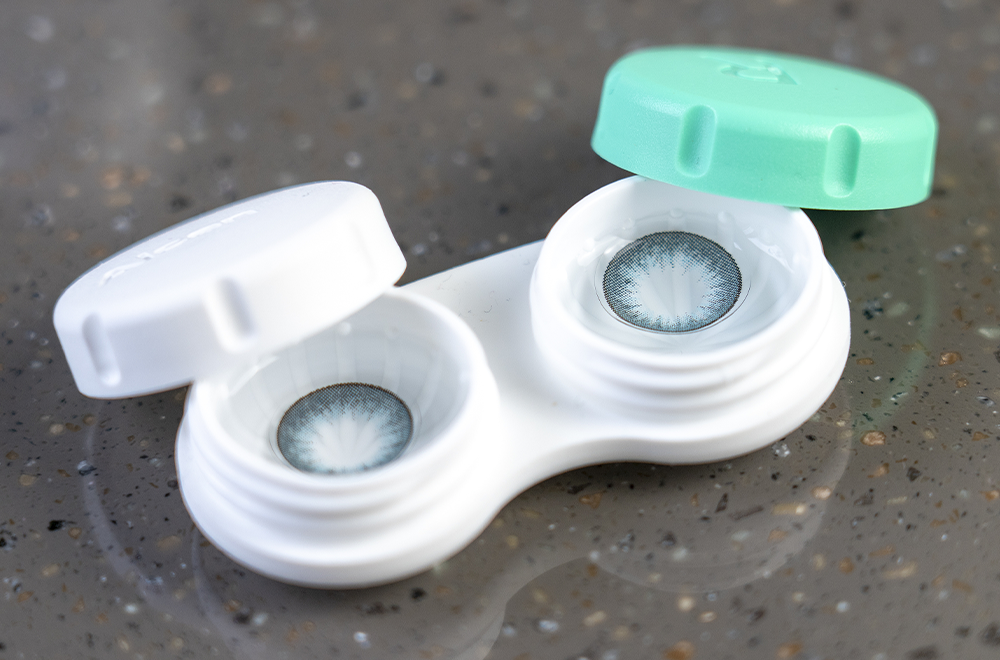
If you are asking are contacts expensive, the hidden fees are often the culprit. Smart wearers keep a backup pair for tears, loss, or travel disruptions. For daily wearers, that means an extra 30-pack. For monthly wearers, an extra pair. This buffer adds 5–10% to your true annual contact lens cost.
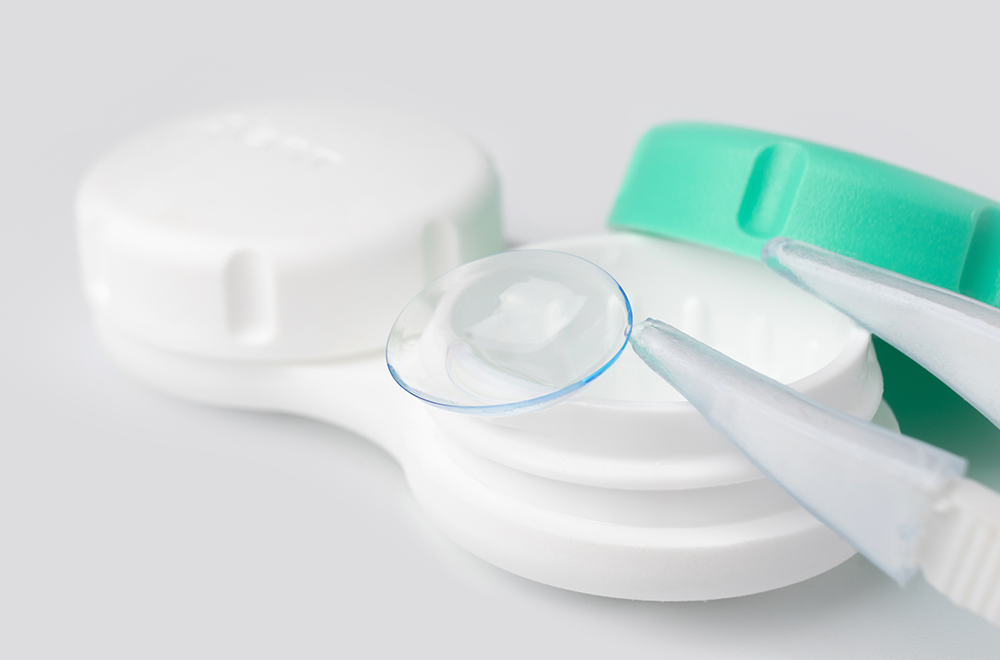
Buyer Profile Matrix: Match Your Lifestyle to the Right Lens
The Daily Warrior (Wears 6–7 Days/Week)
You need the lowest cost per wear and the highest oxygen permeability. Silicone hydrogel monthlies like Biofinity or Air Optix Plus HydraGlyde offer Dk/t values above 100, allowing extended daily wear without corneal stress. Most modern soft contact lenses fall into this category.
Your annual contact lens cost lands around $580 including solutions, but your cost per wear stays under $1.60.
Prioritize bulk annual-supply purchases to capture manufacturer incentives. If you are estimating how much is a year supply of contact lenses, factor in both the box price and the solution tax.
For daily wearers who need vision correction without color, LolaDiva
Hydrogel Clear Lenses offer the same FDA & CE certified hydrogel technology with flexible replacement schedules to match your routine. These hydrogel contact lenses provide reliable clarity for 2-week, 1-month, or 1-year wear cycles. Pure clarity and all-day moisture from $14.99/pair.
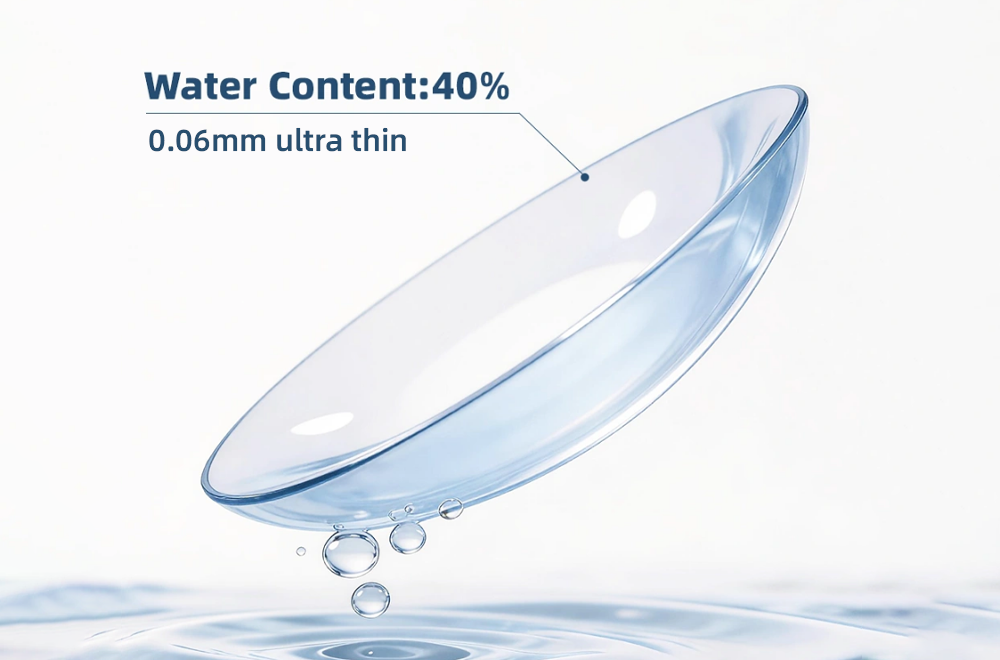 • Hydrogel Clear 2-Week Lenses
 — Short-term convenience, long-term comfort. From $6.66/pair.
• Hydrogel Clear 1-Month Lenses — Balanced wear cycle for regular users. From $10.99/pair.
• Hydrogel Clear 1-Year Lenses — One pair, 12 months of reliable vision. From $14.99/pair.
For the ultimate daily convenience with premium oxygen flow, LolaDiva
Silicone Hydrogel Daily Clear, PFAS-Free delivers 100.4 Dk/t oxygen permeability with zero maintenance. These silicone hydrogel contact lenses offer higher breathability than traditional hydrogel alternatives. FDA & CE certified. UV blocking. Only $0.9/lens.
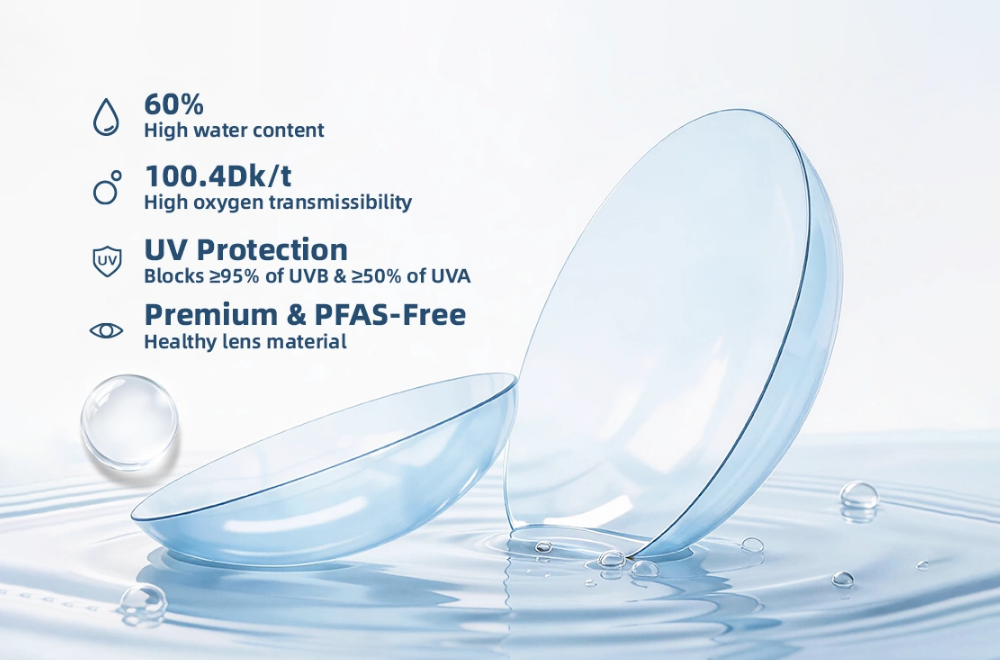 • Silicone Hydrogel Daily Clear 10-Pack
 — Perfect trial size for first-time users. $0.9/lens.
• Silicone Hydrogel Daily Clear 30-Pack — One full month of breathable, PFAS-free clarity. $0.9/lens.
• Silicone Hydrogel Daily Clear 60-Pack — Bulk value for committed daily disposable users. $0.9/lens.
• Silicone Hydrogel Daily Clear 90-Pack — Maximum savings for long-term daily wearers. $0.9/lens.
The Weekend Switcher (Wears 2–4 Days/Week)
You alternate between glasses and contacts. Monthlies are your worst enemy because expiration kills your economics. Daily disposables—or daily throw away contact lenses—win here. No solution. No case. No waste.
Your cost per wear is higher in absolute terms. But you avoid the $175 contact lens solution cost and the guilt of throwing away a monthly lens you opened but barely wore.
If you want color enhancement for social events, LolaDiva
Daily Colored Contacts use the same soft hydrogel as clear lenses, with the pigment safely encapsulated inside. FDA/CE/ISO-certified. Fresh lens every day. Zero cleaning. Zero storage. Full freedom. From $1.99/pair.
• Kiwifruit Green Daily Contacts — Vibrant green for a playful, standout look. From $1.99/pair.
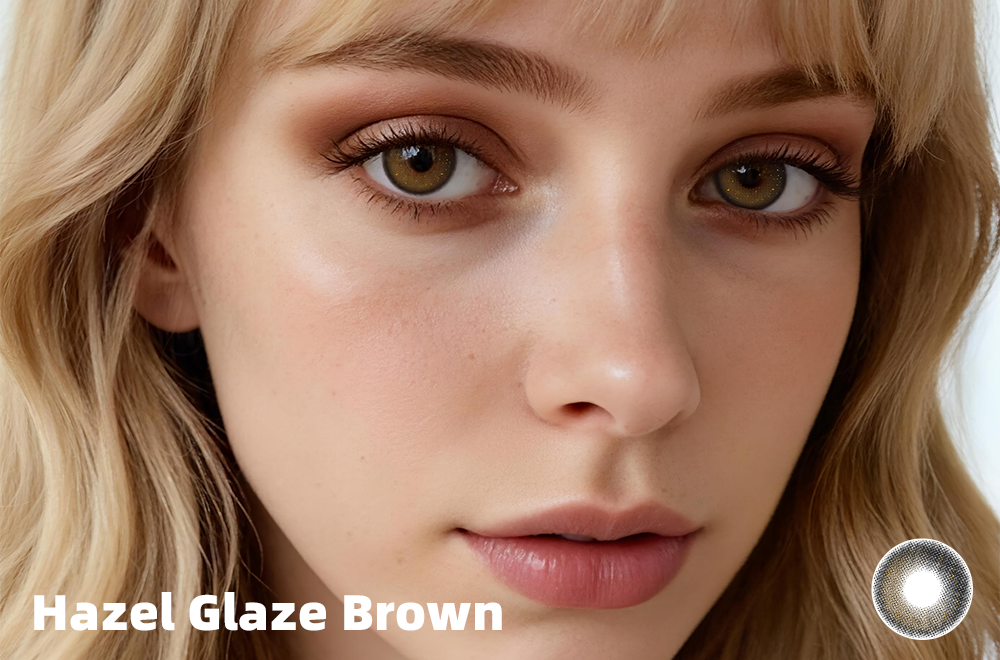
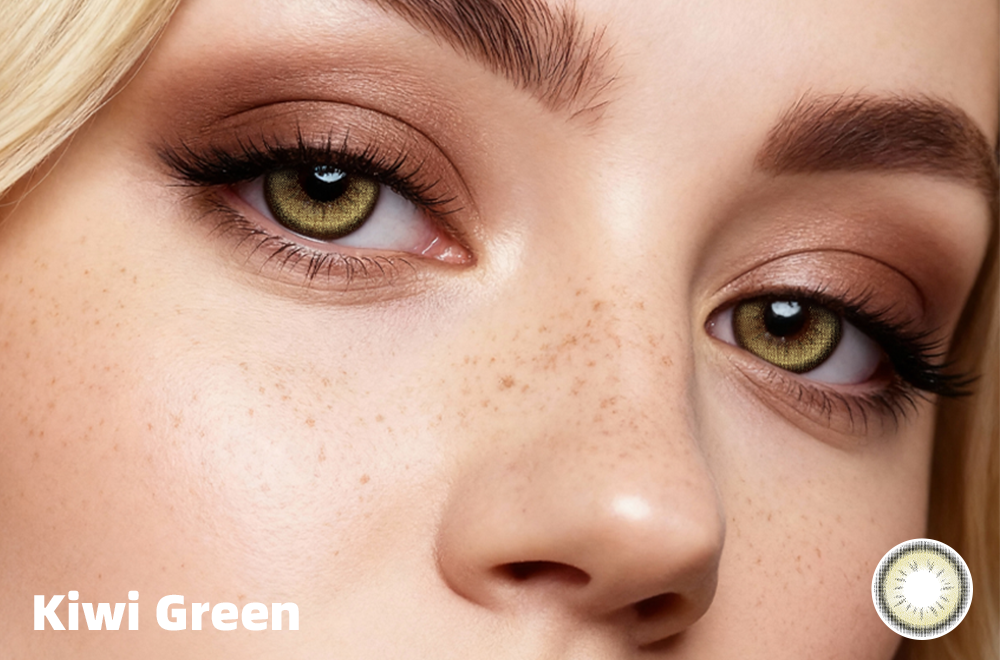 • Hazel Glaze Brown Daily Contacts
 — Warm brown blend for natural daily wear. From $1.99/pair.
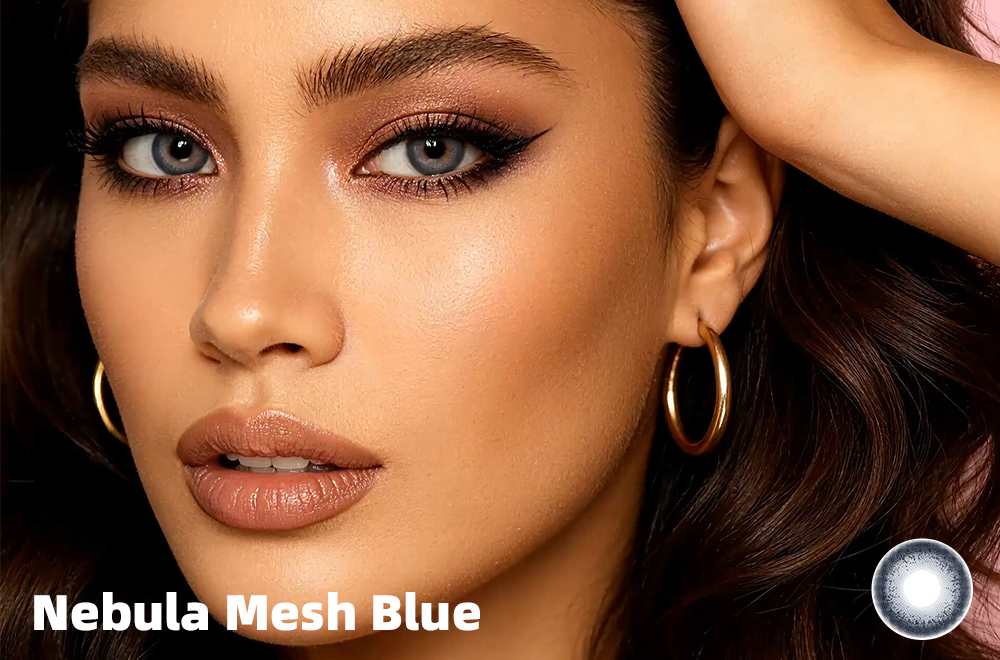
 • Nebula Mesh Blue Daily Contacts
 — Rich hazel for subtle depth and glow. From $1.99/pair.
The Aesthetics-First Wearer (Color & Style Priority)
If your primary goal is eye-color transformation rather than vision correction, the economics shift dramatically. Brand-name monthly colored lenses from major manufacturers run $45–$60 per box (two lenses). That is why so many shoppers ask how much do colored contact lenses cost before discovering DTC alternatives. That is $270–$360 annually for six boxes, plus solution. When you total how much do contact lenses cost per year, brand-name color lenses often exceed $400.
But FDA-cleared 1 year colored contacts from direct-to-consumer brands like LolaDiva cost under $6 per pair with proper care protocols. At three wears per week, your cost per wear drops to approximately $1.26, including solution and exam fees.

The key difference: you trade the premium brand markup for a simplified supply chain, while still maintaining CE and ISO-certified manufacturing standards. For style-first buyers, this is the hidden bargain no traditional contacts price guide mentions. While some search where to buy colored contacts in store, online DTC brands typically offer the lowest cost per wear.
LolaDiva
1-Year Colored Contacts — FDA/CE/ISO Certified. Lasting hydration. Stable color. All 365 days. Why pay $45+ per box for brand-name colored lenses when the same FDA/CE/ISO-certified safety costs under $6? One pair. One year. Zero compromise.
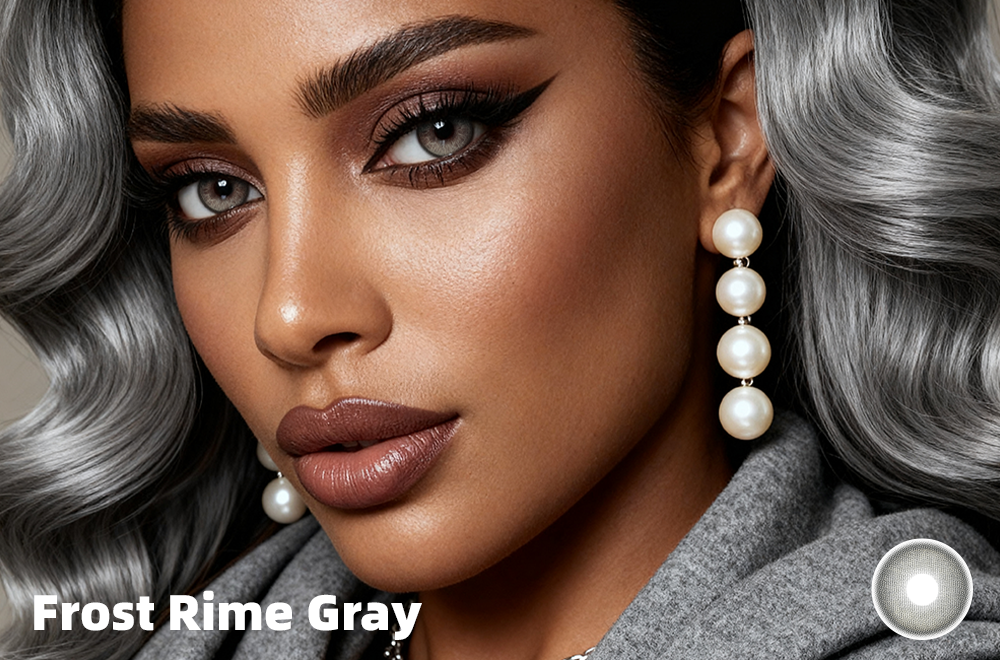
• Frost Rime Gray 1-Year Lenses — Icy gray tones with all-day moisture retention. $5.99/pair.
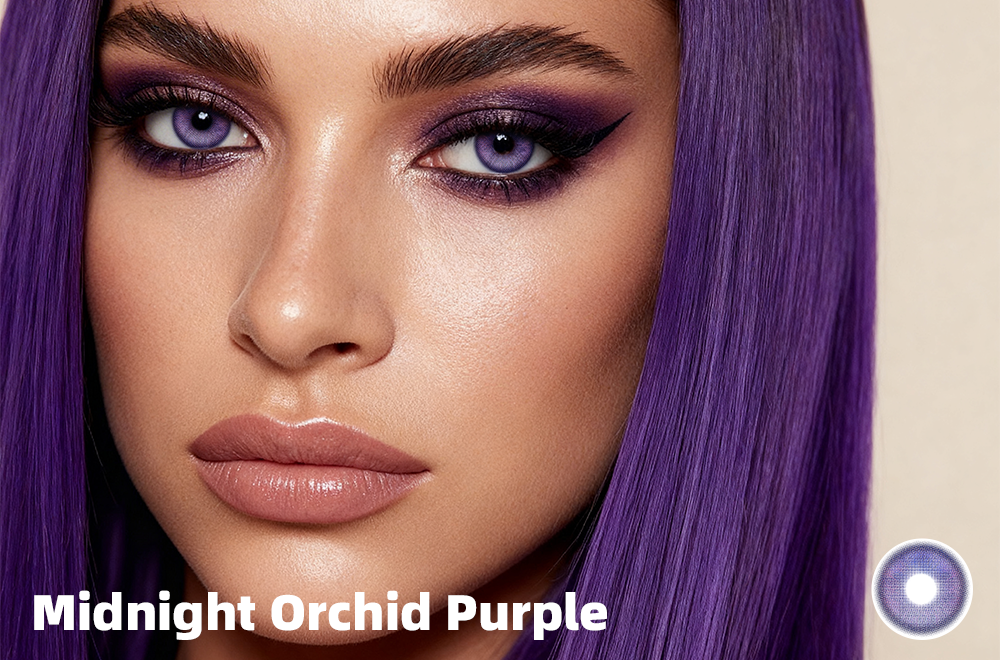
 • Midnight Orchid Purple 1-Year Lenses
 — Deep violet pigment engineered for 365-day color stability. $5.99/pair.
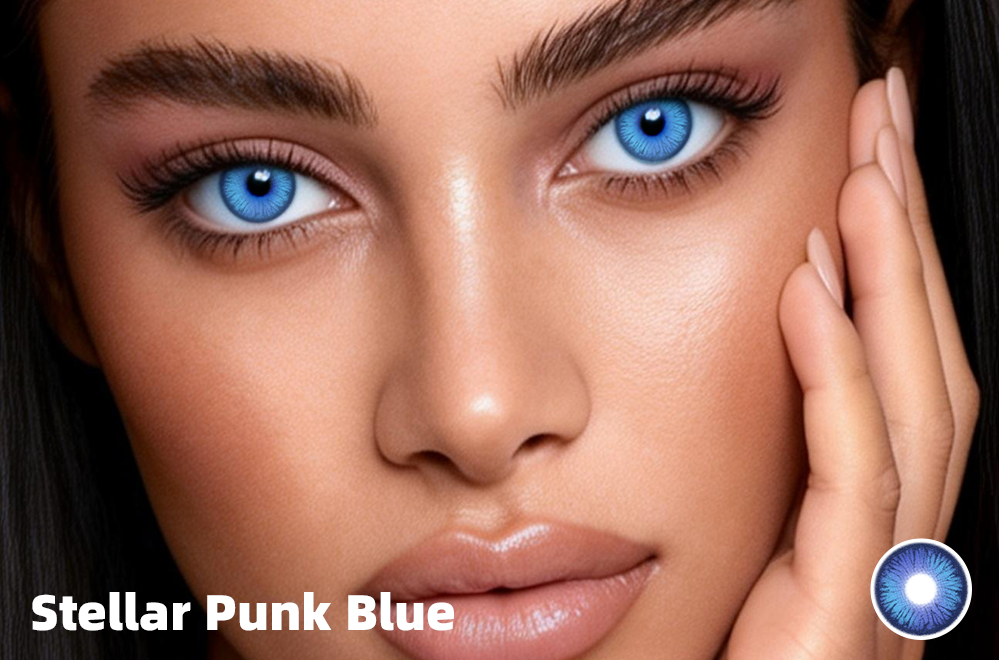
 • Stellar Punk Blue 1-Year Lenses
 — Bold blue with FDA-cleared hydrogel base. $5.99/pair.
The Counter-Intuitive Truth: Why LolaDiva FDA/CE-Certified Colored Contacts Can Cost Under $6
Many consumers see LolaDiva's
yearly colored lenses priced under $6 and their first reaction is: "This cheap? Is it really safe?" That instinct is understandable, but it conflates two separate concepts.
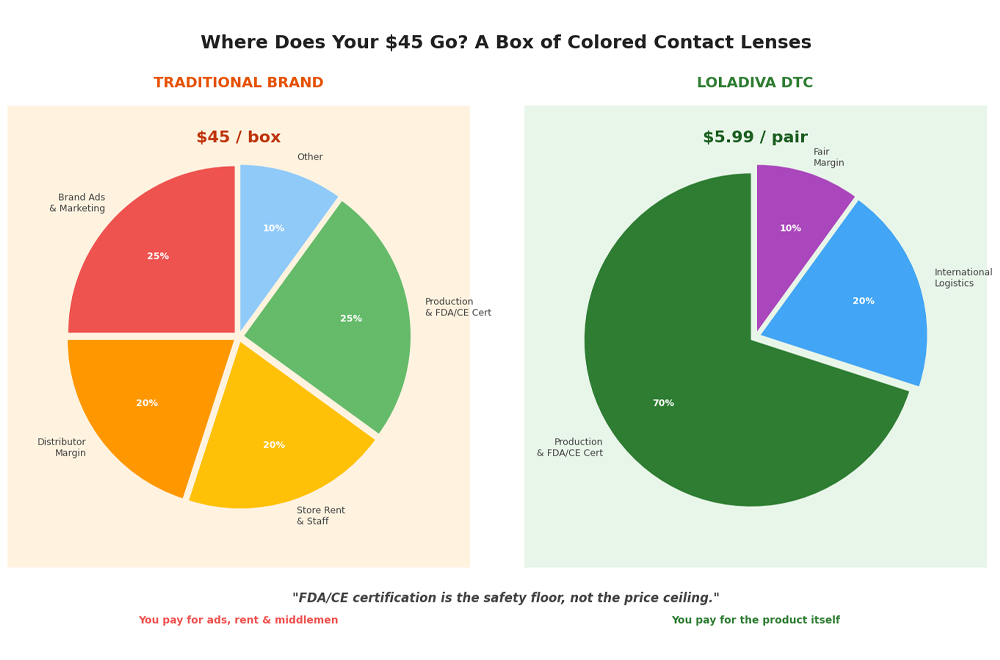
FDA/CE certification is a safety threshold. Price is a business-structure problem. Lenses cleared through FDA 510(k) or CE marking have already met medical-grade standards for material oxygen permeability, water content, edge design, and sterile production. Cheap does not mean substandard. Meeting standards does not require being expensive.
Traditional contact lenses travel through four layers: manufacturer → national distributor → regional wholesaler → retail terminal. Each layer extracts 30–50% margin. LolaDiva uses a DTC (Direct-to-Consumer) model, shipping factory-direct to the wearer and cutting out three intermediaries. This is supply-chain disintermediation, not cutting corners.
Johnson & Johnson (Acuvue), Alcon, and CooperVision spend hundreds of millions annually on global advertising, physician-channel incentives, and brand maintenance. These costs are amortized into every box's contacts price, creating a "brand tax." A new brand does not ask you to pay for thirty-year-old advertising bills.
Physical optical shops absorb rent, staffing, and inventory costs that account for 40–60% of traditional retail pricing. Purely online brands carry none of these overheads. This is a cost-structure reset, not low-cost operation.
Over 70% of global contact-lens capacity is concentrated in Asia. LolaDiva leverages localized, scaled production, shortening cross-border logistics, tariffs, and transshipments.
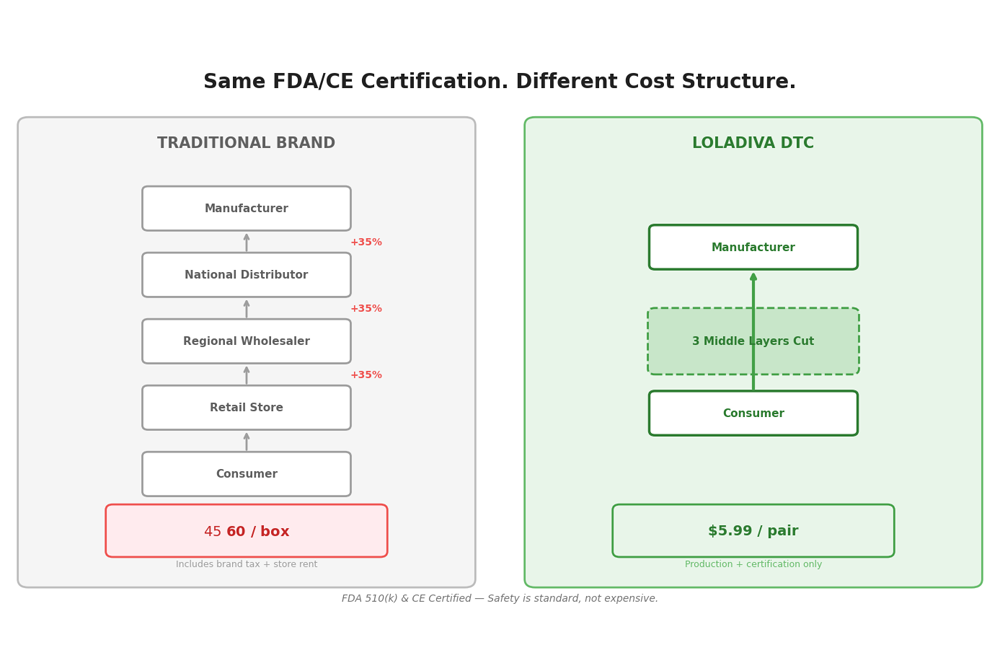
FDA 510(k) and CE certification are one-time compliance costs. Once cleared, higher volume drives the per-unit amortized cost toward zero. Legacy brands exploit this for premium margins. DTC brands pass those scale economies to consumers.
For wearers with normal vision, colored contacts are a fashion accessory, not a medical necessity. However, corrective colored contacts that include vision correction remain classified as medical devices and require a valid prescription. Paying a medical-grade premium for a cosmetic tint is market-pricing distortion.
LolaDiva's logic is simple: return colored contacts to a price befitting a small accessory. Paying excess for one date or one selfie is economically irrational.
LolaDiva is not a spokesperson for "cheap colored contacts." It is a defender of fair pricing. FDA and CE certification guarantees the safety floor. DTC logistics breaks the unnecessary price ceiling. High quality at a fair price is not the exception. It is what the market was always supposed to look like.
The 3-Step Price Audit Checklist
Before your next purchase, run this audit:
Calculate your real wear days. Be honest. If you wear lenses 120 days per year, not 365, your math changes completely.
Compute true cost per wear. Add lenses + solution + cases + exam fee. Divide by actual wear days. Compare across modalities.
Stack the discounts. Confirm your vision insurance coverage network status. Check manufacturer rebate eligibility for annual supplies. Pay with FSA/HSA funds if available. The intersection of these three layers is where the real savings live.

Frequently Asked Questions
Q: Why does the same contact lens brand cost different amounts at different stores?A: Retailers operate on different margin structures. Online stores compete on volume and subscription models. Private practices compete on service, fitting expertise, and rebate stacking. Costco competes on membership-driven bulk pricing. The same SKU can legitimately vary by 40–60%.
Q: Are daily contacts more expensive than monthly contacts?A: Only if you wear them full-time. At 6–7 days per week, dailies cost roughly $2.47 per wear versus $1.59 for monthlies. But at 2–3 days per week, the gap narrows or inverts because monthlies expire on a calendar schedule, not a usage schedule. For part-time wearers, dailies are often the smarter financial choice.
Q: How much does it cost to get contacts?A: If you are wondering how much does it cost to get contacts, the answer includes three components: the lenses, the solution, and professional fees. Most wearers spend between $250 and $900 per year depending on modality and insurance. Those asking how much are contact lenses without insurance should expect to pay full retail unless they qualify for rebates or FSA/HSA discounts.
Q: How much do prescription contacts cost?A: How much do prescription contacts cost depends on your vision needs. Standard spherical lenses start around $200 annually. However, if you need toric or multifocal designs, prices rise significantly. Many shoppers ask how much are multifocal contact lenses or how much are contact lenses for astigmatism—these typically run 20–40% higher than basic spheres.
Q: Do you need a prescription for contact lenses?A: Yes. In the United States, do you need a prescription for contact lenses is a common question, and the answer is legally mandated. Contact lenses are FDA-regulated medical devices. Even zero-power plano cosmetic lenses require a valid prescription. This rule applies to all prescribed colored contact lenses sold in the US.
Q: Can I use FSA or HSA for colored contact lenses?A: Only if they are prescription lenses that correct vision. Purely cosmetic plano colored lenses are not FSA/HSA eligible under IRS rules. However, if your colored lenses contain a prescription (even a zero-power plano cosmetic lens requires a valid prescription for safety regulation compliance in the US), they qualify. Always check with your plan administrator.
Q: How much does a contact lens exam and fitting cost?A: In 2026, how much is an eye exam for contact lenses ranges from $100–$250. Patients also wonder how much does a contact lens prescription cost separately; the exam fee typically includes the prescription write-up. Toric and multifocal fittings often land at the higher end ($150–$250). If you are comparing how much is contact lens exam at costco versus private practice, warehouse clubs often charge slightly less but may have limited availability. This fee is separate from the lens purchase and is often partially covered by vision insurance.
Q: Does vision insurance cover contact lenses?A: Many plans do, but coverage varies. If you are asking does vision insurance cover contact lenses or are contact lenses covered by insurance, check your VSP, EyeMed, or employer plan details. Most in-network plans cover the exam and provide an annual materials allowance.
Q: Does Walmart sell contacts?A: While this guide focuses on cost structures, many readers ask does walmart sell contacts. Yes, Walmart Vision Centers offer contact lens exams and sell major brands, though pricing and rebate stacking options may differ from online DTC retailers.
Q: What is the best contact lens replacement schedule for saving money?A: There is no universal answer. Your optimal contact lens replacement schedule depends on your wear frequency, prescription complexity, and willingness to maintain a cleaning routine. Full-time daily wearers usually save with monthlies. Part-time wearers often save with dailies. Always prioritize eye health over cost; wearing lenses beyond their approved schedule to save money risks infection and corneal damage.
Medical Disclaimer & Safety Notice
This article is for informational and educational purposes only and does not constitute medical advice, diagnosis, or treatment. Contact lenses are FDA-regulated medical devices. Always consult a qualified eye care professional before selecting or changing your lens type, replacement schedule, or care routine.
Individual eye health, corneal shape, and tear film quality vary significantly. Never purchase contact lenses without a valid prescription from a licensed optometrist or ophthalmologist.
Improper lens use, including overwear, poor hygiene, or unapproved overnight wear, can cause serious eye infections, corneal ulcers, and permanent vision loss. If you experience redness, pain, blurred vision, or light sensitivity while wearing contact lenses, remove them immediately and seek professional medical attention.


