
Green is the color most people screenshot and then talk themselves out of — too bright, too costume, too much. Aurora Green is built to answer that doubt before it starts: a 3-tone opaque green with a grey-green dotted rim, yellow-green radial fibers running through the middle ring, and golden-amber warmth folded into the print. The high-opacity pigmentation is what makes it work on dark brown eyes instead of washing out on them, and the transparent pupil window — the open circle at the centre of the print — is what keeps it from looking like a painted disc up close.
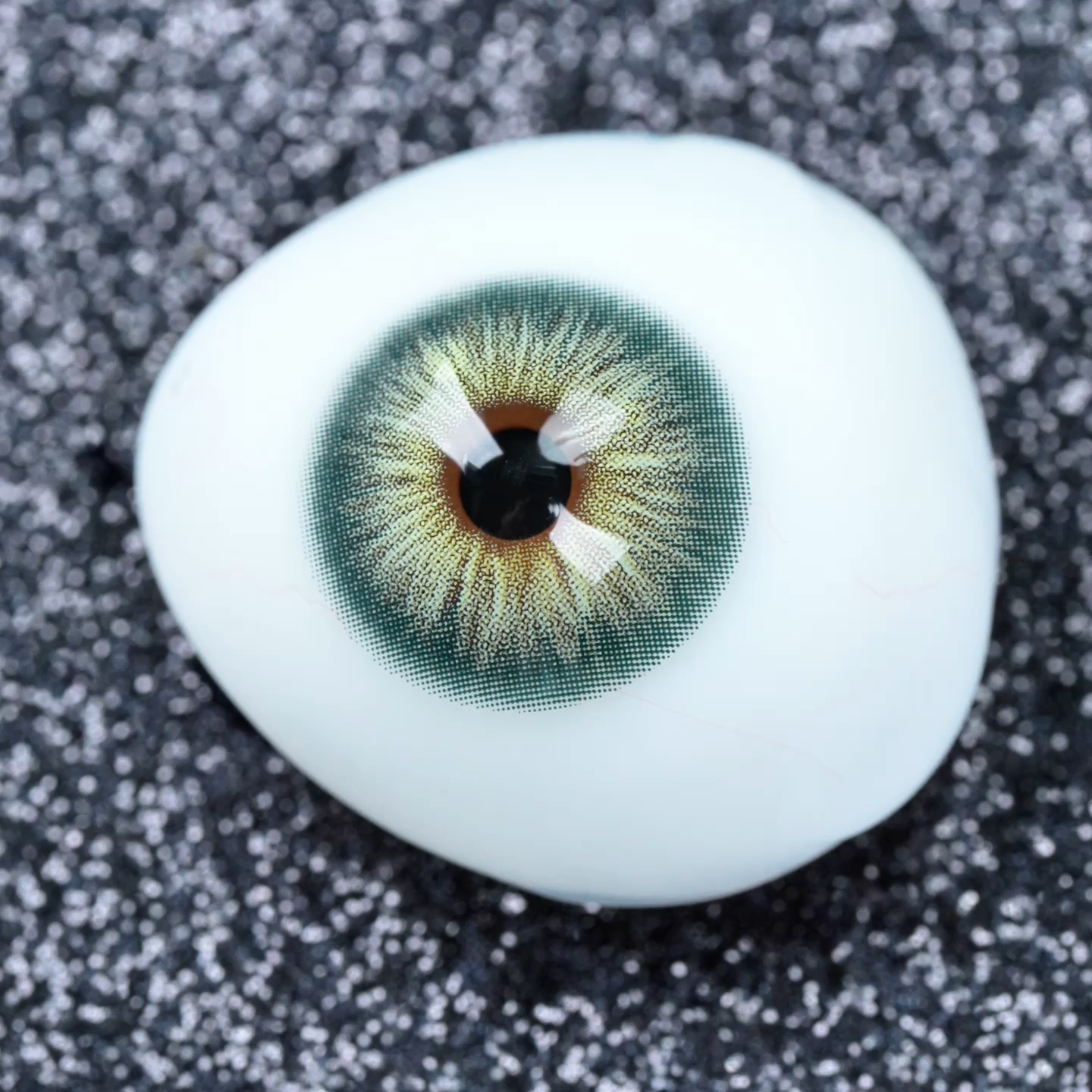
So this is a close read of one shade: what changes on your eye, how it behaves on light versus dark irises, what the print signals from arm's length, and how it holds up through a full wear day. Want the look for yourself? Shop the LolaDiva Aurora Green 1-Year Contact Lenses ($5.99)

The close-up tells the story honestly. On the model's dark brown eye — fair, cool-pink skin, pink-brown shimmer shadow, winged liner and full lashes — the lens shifts the iris to a luminous grey-green: the dotted outer rim sets a defined edge, the yellow-green radial fibers fill the middle ring, and a trace of the natural brown still glows through the clear center. That is the difference between "wearing green contacts" and "having green eyes" — the lens changes the ring and the texture, but leaves a living pupil area.
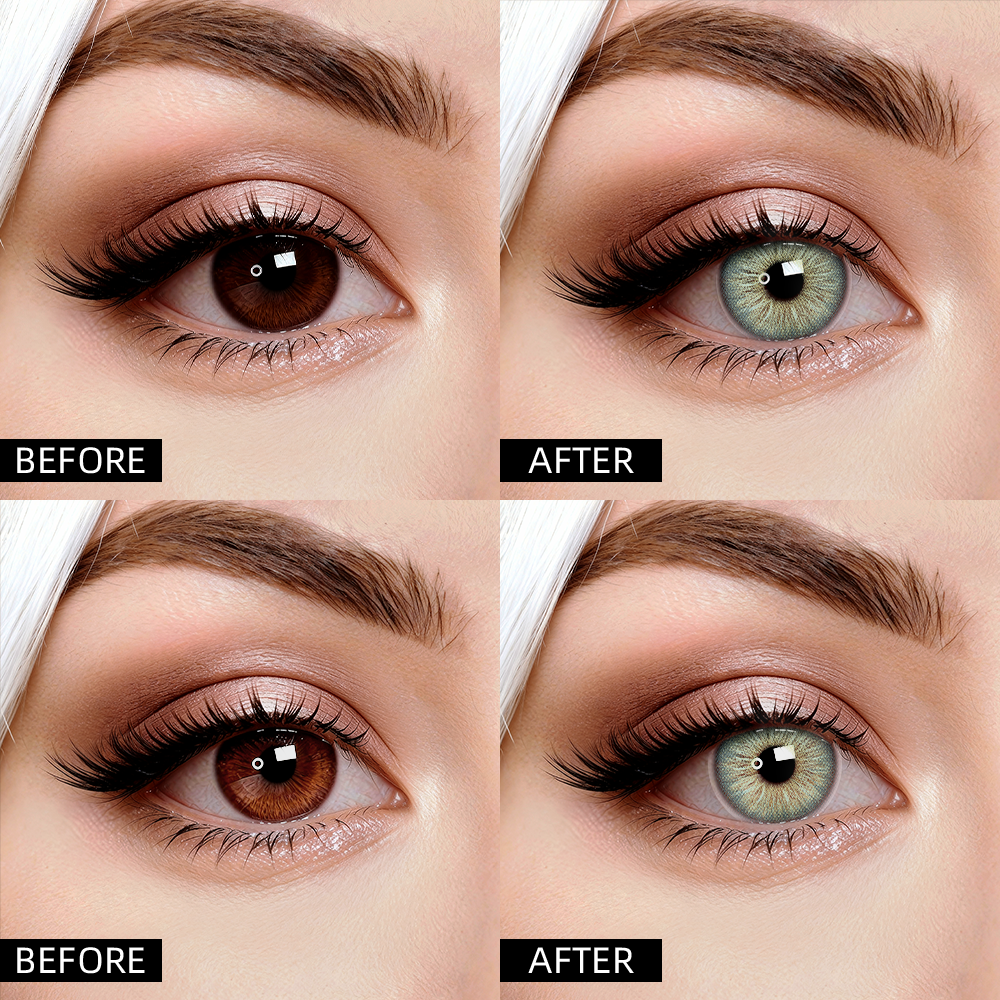
The before-and-after frames show the transformation on a deep brown iris: the opaque 3-tone print covers fully — deep brown becomes a bright, gem-toned grey-green with the radial fibers clearly visible, not a flat green overlay. On lighter irises the effect runs the opposite way: less coverage needed, so the same print reads softer and smokier, closer to a natural green-grey eye. Either way, the shape of the color stays consistent because the print, not your base tone, is doing most of the talking.
From arm's length, Aurora Green reads as an intentional color choice rather than a costume one. The grey-green rim keeps the edge natural — it mimics the darker outer ring a real iris often has — while the yellow-green fibers add the kind of variation real green eyes carry. The style is listed as natural, and the design earns the label: nothing in the print is a solid block of color.
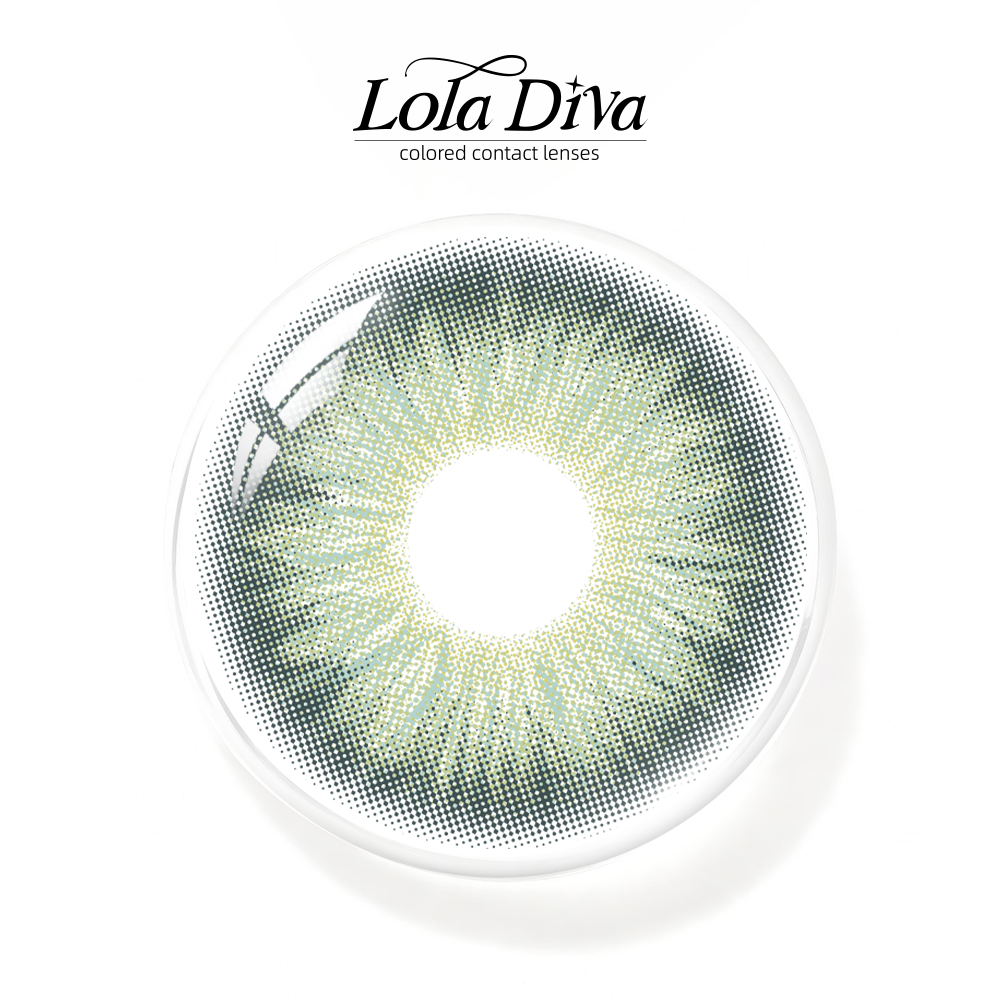
The flat product render shows the print structure clearly. The grey-green dotted rim forms the outer boundary; inside it, yellow-green fibers radiate inward with amber-gold warmth mixed in; and at the very centre, the pupil area is left transparent. That clear center is the most important design decision on the lens — it means your own eye color participates in the final result instead of being erased by it.
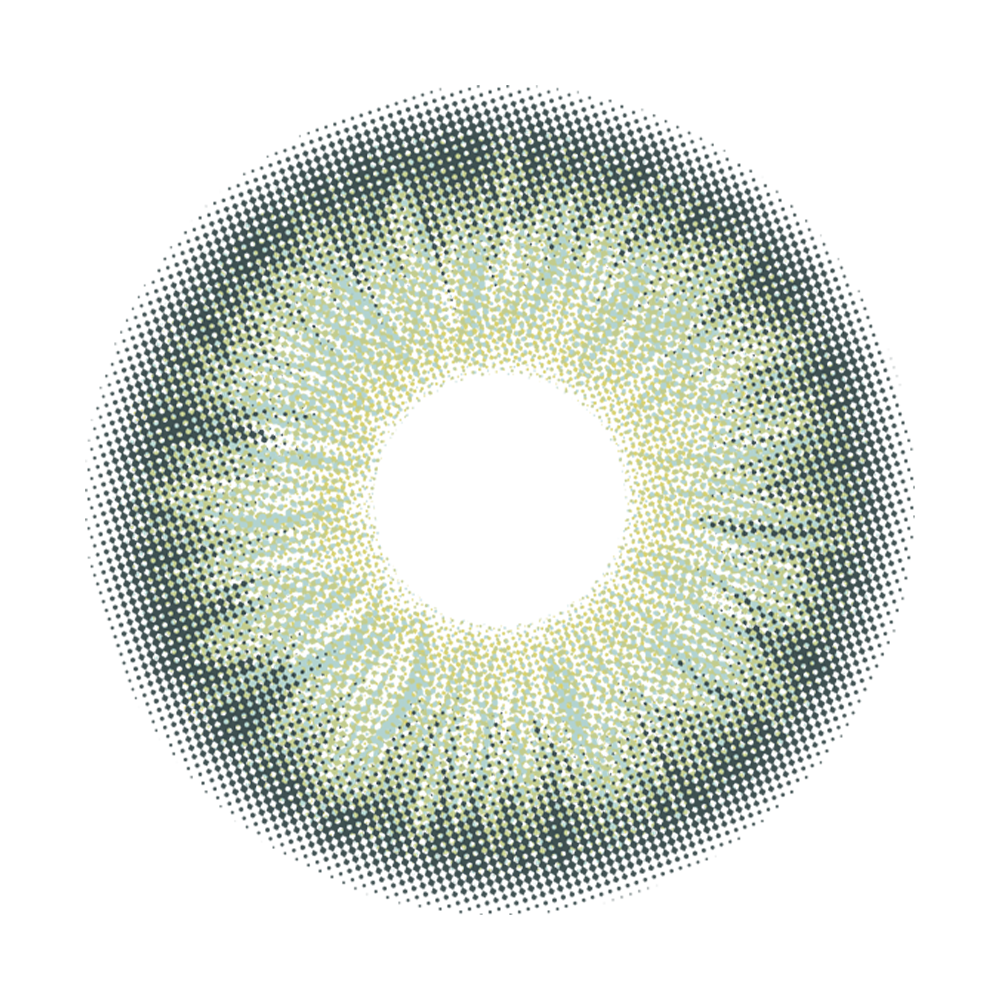
Zoom in and the print stops looking like a color and starts looking like a craft object. The macro view shows the dot matrix of the rim, the individual radial fibers, and how the three tones — the yellow-green, the pale aqua, and the deep ink-green listed on the spec card — layer over each other. This is also where you can see why the color shifts with light: the fibers catch brightness, the dotted rim absorbs it, and the mix reads differently at every distance.
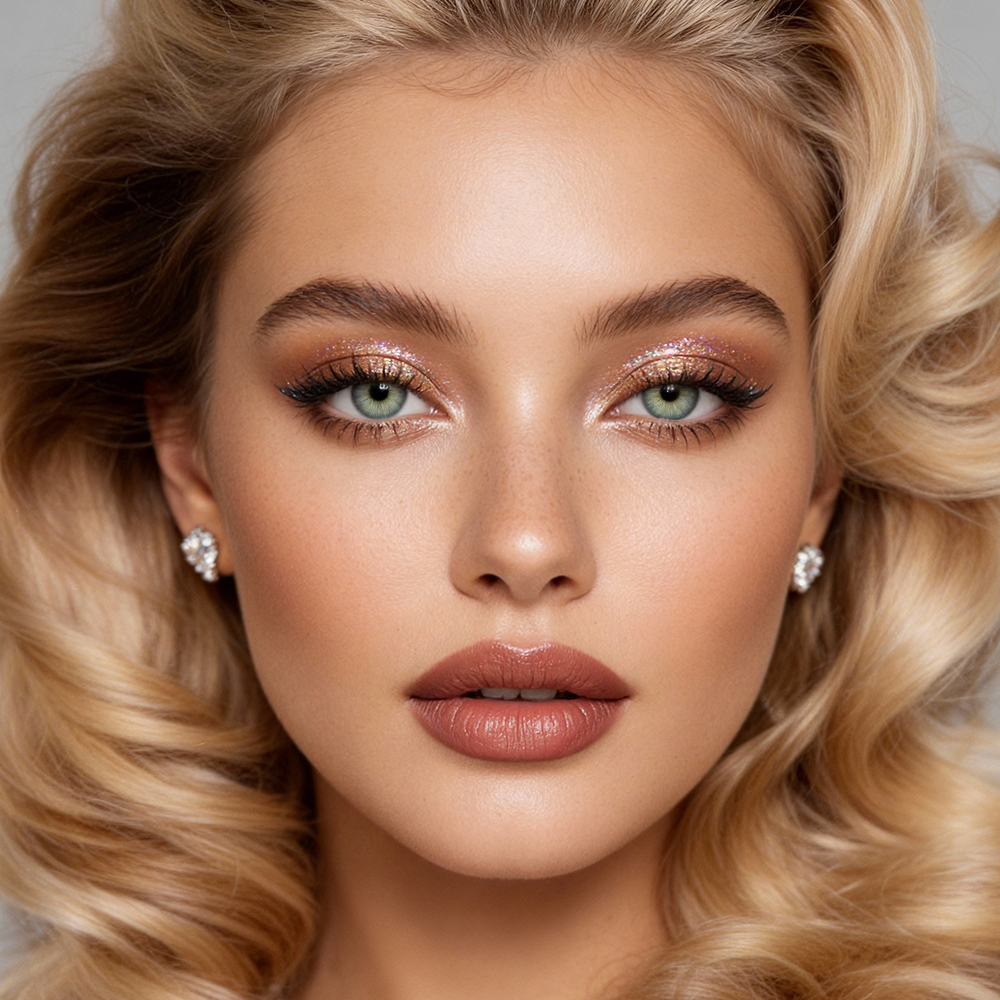
Light changes the temperature of this green more than its identity. In the warm, even light of the full-face shot — soft pale backdrop, fair warm-toned skin, copper-pink shimmer across the lid — the grey-green lifts toward sage and the gold in the print stops competing with the shadow, so the two read as one family of warm neutrals. Flatter, cooler light pushes the other way: the dotted rim does more of the defining and the fibers recede into a quieter grey. The one constant is that the green never goes flat, because the fiber texture keeps breaking up the color at every light temperature.
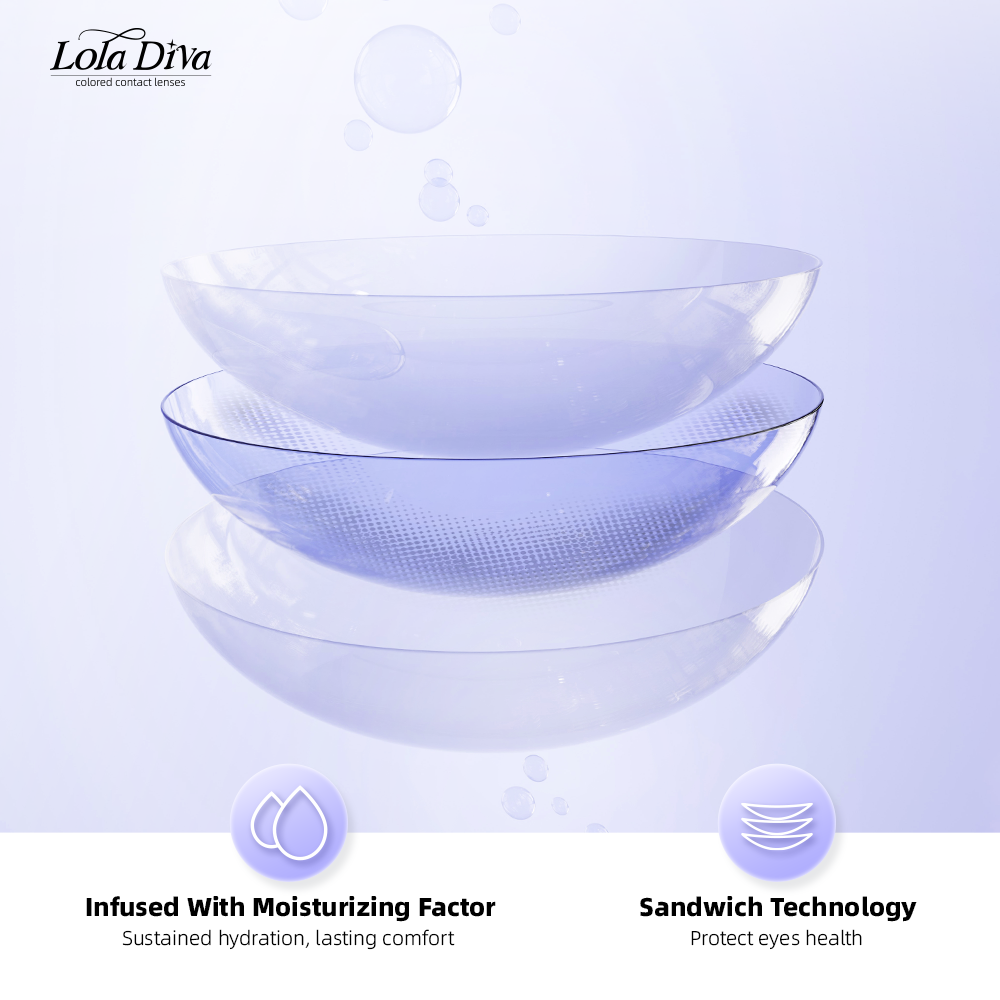
A print this layered needs protection to stay this way for a full year, and the construction handles that. The pigment sits inside a sandwich structure — sealed between layers so the print never contacts the eye surface — and the material is infused with a moisturizing factor alongside its 40% water content, with oxygen transmission rated at 12 Dk/t. Wash hands before handling, store in fresh solution, and the print that looks this crisp in the macro shot stays crisp through the 1-year replacement cycle.
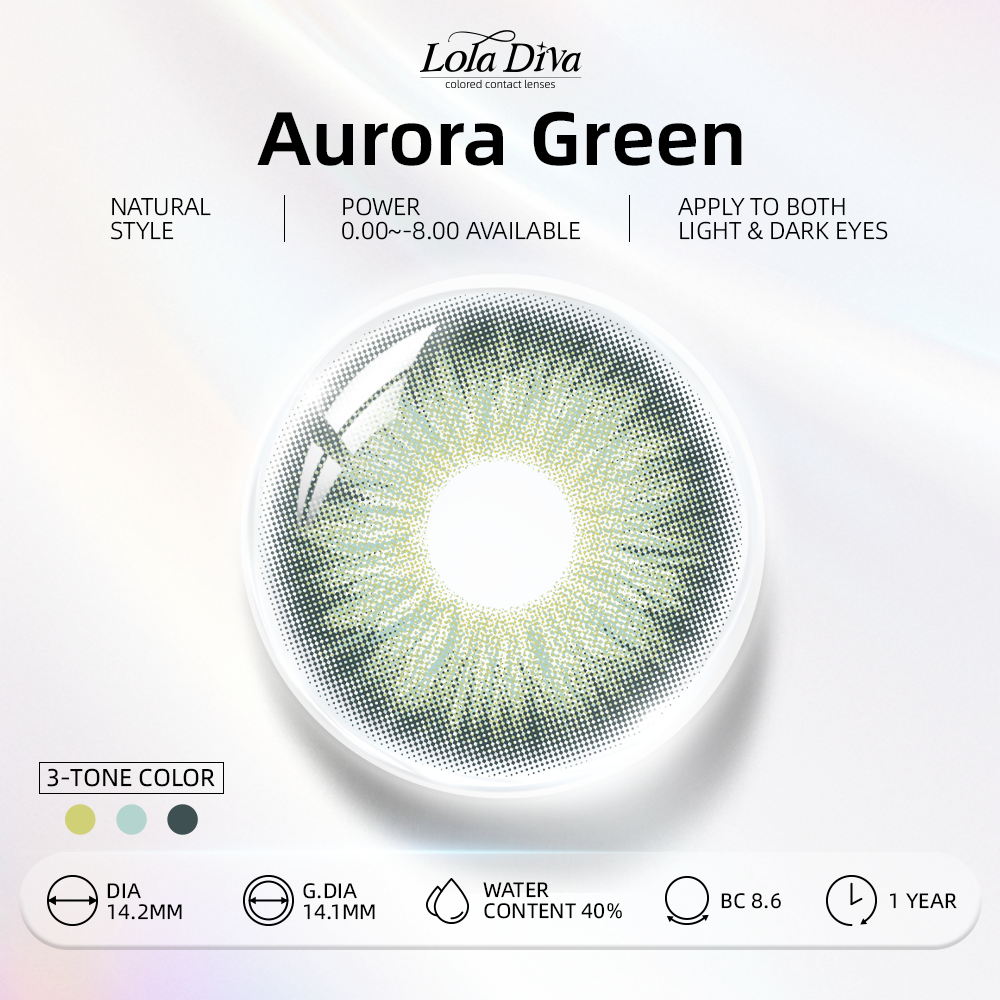
The printed specification card confirms the details behind the look: DIA 14.2mm with a graphic diameter of 14.1mm for full coverage, base curve 8.6, water content 40%, one-year replacement cycle, and power from 0.00 to -8.00 so plano and prescription wearers order the same shade. The style is listed as natural, the print as 3-tone, and the lens is rated to apply to both light and dark eyes.
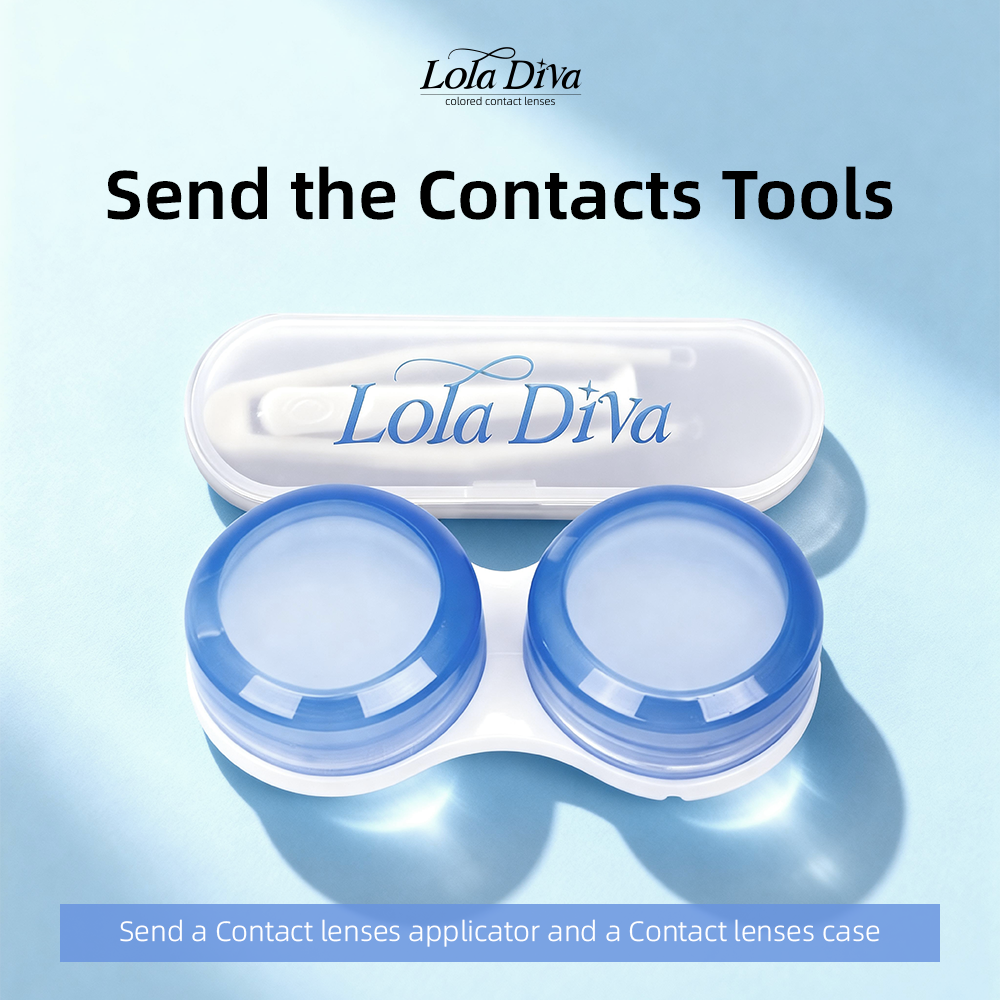
The package is the practical half of the buy: the lens pair, a contact lens applicator, and a contact lens case.
Judge this shade on a dark eye and a light one if you can — that contrast is the whole point of the design.
Aurora Green is a high-opacity 3-tone green built around one idea: change the ring, keep the eye alive. The grey-green dotted rim and yellow-green radial fibers do the transforming, the amber warmth keeps the color human, and the transparent pupil center lets your own eye color stay part of the result. On dark brown eyes it covers fully into a luminous grey-green; on lighter irises it softens into a smokier version of the same print. The 14.2mm diameter with a 14.1mm graphic diameter does the enlarging, and the sandwich-sealed print keeps the pigment off the eye surface for the full 1-year cycle.
Q: Will Aurora Green actually show up on dark brown eyes?
A: Yes. It is an opaque 3-tone print, and the before-and-after frames show a deep brown iris shifting to a bright grey-green with the radial fiber texture still visible — coverage is the design's starting point, not an afterthought.
Q: Is this a plano lens or a prescription lens?
A: Both. Power runs from 0.00 to -8.00, so plano wearers and prescription wearers within that range order the same shade.
Q: How long does one pair last?
A: It is a 1-year replacement lens sold as a pair. That lifespan assumes the daily routine holds: clean hands, fresh solution, no sleeping in lenses.
Q: What comes in the box?
A: The lens pair, a contact lens applicator, and a contact lens case.
FDA - Decorative Contact Lenses for Halloween and More
American Academy of Ophthalmology - Decorative Contact Lenses
2pcs LolaDiva Aurora Green | 1-Year Contact Lenses
AOA - Decorative Contact Lenses
What Are Contact Lenses Made Of? A Complete Material Science Guide (2026)
What Is BC of Contact Lenses? The Complete Guide to Base Curve, Fit & Eye Health


